
Poetry
|
Poetry |
|
My Father, 12 years after his Death Most of all – Ray Skjelbred |
|
Collections Of Poems by Ray Skjelbred |
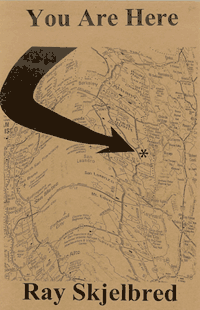 |
from YOU ARE HERE The Jackal The jackal cannot curl his lip You can scare him away He wants you to believe in him. |
from GREATEST HITS Sycamore One day all the leaves blow away. |
|
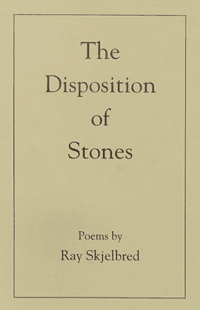 |
from THE DISPOSITION OF STONES Magic Show You see him sawing a woman in half Well, she needed a job, Most of all she learned to stay silent, |
If you would like to mail order the above booklets, Also you may check with Ray at live performances. |
Ray Skjelbred Looking back on my childhood, I have often thought about where the poetry was–certainly not in actual poems (with which I had no experience), but in the events of daily life and in the memory skills that grew from the angles of light and the sound/sight/word thought associations that I accumulated in those days. I grew up on the north side of Chicago, loved baseball and hot weather, got up early to listen to the birds in the courtyard of our apartment building, took long walks to see the neighborhood and spent hours reading baseball magazines and Donald Duck comic books. In high school, Carl Sandburg was the first poet I knew, and I'm sure his open forms appealed to me. Though I don't read him anymore, I have a good feeling about the experience. I didn't exactly fit into my high school world, but I was realizing that other people, writers in particular, had been in this place before and gave me a kind of permission to follow some sort of true self that I didn't quite understand yet. I also have strong memories of studying Eugene Debs and the Sacco and Vanzetti case. I was turning some direction for sure, but I sill wasn't writing. Not really. At the University of Washington in Seattle I became an English major, spent as much time as possible reading fiction and realized that, of course, I was going to be a teacher. Poetry came to me in big historical chunks and I enjoyed most of it, though "modern" poetry always ended around the time of Dylan Thomas. I made my first deep attachments to poets then–to Thomas Hardy, Emily Dickinson and William Carlos Williams. It wasn't until I had been teaching a few years that I bumped into many of the "modern" poets for the first time, the writers who seemed to all begin in the 1960's and who, despite their differences, wrote about places and experiences that were the kind I wanted to write about. Their language roamed into unexpected corners and seemed beautifully plain and unpretentious. They observed the little things of daily life, they listened to the clustering sounds of words and suddenly I was in a new world. I am thinking here primarily of William Stafford, James Wright, Galway Kinnell, Adrienne Rich, Denise Levertov, Gary Snyder, and Robert Bly, whose poems seemed clear-eyed and neither uncomfortably limited by traditional forms, nor loud and full of timely political ranting. I usually write my poems between 4 and 6 in the morning. Things just come along. And I read aloud, over and over as I work. I want one sound to lead to another and I accept what comes, then push it around until the voice and beat seem right. I like to think that the poem itself is the force. Eventually I just say it the right way. That's how I look at public readings too. Say the lines with a clear voice and let the poem carry itself. I'm skeptical about the usual concept of "performance." I like to just say my poems. |
Ray Skjelbred is the author of three poetry chapbooks: You Are Here and The Greatest Hits of Ray Skjelbred, both published in 2002 by Pudding House Publications, and The Disposition of Stones, 1999. His poems have appeared in Lucid Stone, Lilliput, TIger's Eye, Free Lunch, Runes, Blue Unicorn and many other poetry journals. He has also published fiction and has written articles on teaching writing for The Quarterly, the journal of The National Writing Project. The New Pages Literary Magazine Stand said his poems "twist language, sound and imagery playfully to transport readers to those mystical metacognitive plateaus only poetry can take us" In Lines on Lines on Line, Judith Offer said, "Skjelbred is a poet whose forte is the unexpected angle from which he views the world." |
| Hello, here are my informal thoughts! I would like to put in some of my poems in a shifting rotation, but also poems by others that I would like to share. Not every day, but often. My books can be found through Pudding House and I have them too. One CD "Piano and Poetry" blended music and poetry and I included some of my best writing, but I always kept the music and writing separate, so you really "hear" each. They weave together. |
| A clerihew is an intentionally awkward poem named for a man named Clerihew who wrote that way. The form is actually fun. You begin with the name of someone, then rhyme with it, then add two more lines that rhyme. The poem is an observation about the person but with intentionally exaggerated rhymes and inconsistent line lengths. Here are a few of mine. |
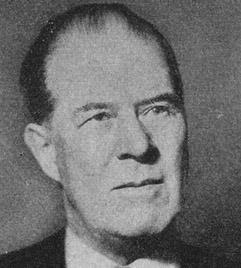 Clerihew |
Antonio Alfonseca Louis Armstrong Thelonious Monk Vice-president Tyler |
| Blues Party A man was playing piano at a party. I've got the blues, I've really got the blues, he thought, as he bent the notes and twisted melodies more passionately and effortlessly than ever before. He looked up and saw a woman crying. Then a man decided to leave his wife. As he strode to the door she threw her arms around his legs and he dragged her down the hallway. Then a woman left her husband and he threw his arms around her legs. Someone screamed that there were bedbugs in the couch. Several others started pulling boll weevils out of their sweaters. A minister pulled a bible out of his pocket and slammed it to the ground. A man in one corner of the room suddenly was aware that he had TB. Another man grimaced and drank a glass of muddy water. A train whistle moaned in the distance. Out the window that evening sun was going down and the streets were lined with broke and hungry people. One frightened old man crawled into a hollow log. In the distance the farmland had turned to dust. Then the rain started. Lightning and thunder. The flood water was rising. Back in the room a woman was shouting about her boyfriend. "I'm gonna stab him through his heart and he's gonna wake up dead." And the piano player kept playing and thinking, I've got the blues, I've really got the blues. |

